

NEWS
Health updates and
clinic news
C13 UREA BREATH TEST FOR H. PYLORI: AN ACCURATE AND SAFE DIAGNOSTIC METHOD
News
Sep 11, 2026
Overview
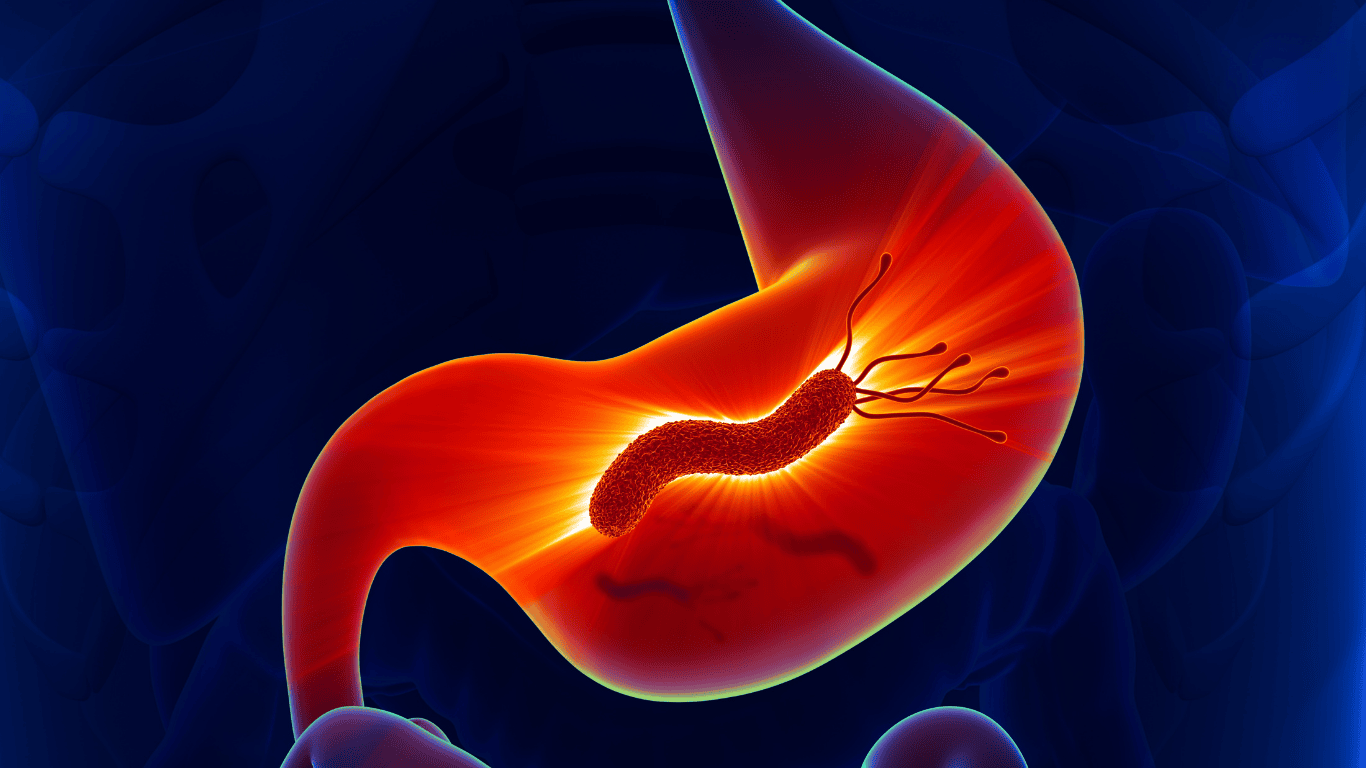
Helicobacter pylori (HP) infection is a primary cause of gastroduodenal ulcers and is significantly linked to gastric cancer. Detecting HP is crucial for effective diagnosis and treatment.
Among the various methods available, the C13 Urea Breath Test (UBT) is recognized as one of the most accurate, safe, and non-invasive techniques, suitable for both adults and children.
What is the C13 Urea Breath Test?
The C13 UBT is a non-invasive diagnostic test used to detect the presence of H. pylori in the stomach.
-
The Principle: H. pylori produces an enzyme called urease, which breaks down urea.
-
The Process: The patient drinks a solution containing urea labeled with a stable carbon isotope (C13). If H. pylori is present, urease breaks down the urea into ammonia and is labeled carbon dioxide C13.
-
Detection: The C13 is absorbed into the bloodstream, exhaled through the lungs, and captured in a breath sample for analysis.
👉 The presence of C13 in the exhaled breath confirms an active H. pylori infection.
When should you perform a C13 Urea Breath Test?
Indications:
-
Symptoms such as epigastric pain, bloating, indigestion, or nausea.
-
Monitoring H. pylori eradication success (at least 4 weeks after stopping medication).
-
Children or adults requiring diagnosis who wish to avoid an endoscopy.
-
Individuals with a history of peptic ulcers or a family history of gastric cancer.
Relative Contraindications:
-
Recent use of antibiotics, bismuth, or proton pump inhibitors (PPIs) within the last 2–4 weeks (may cause false-negative results).
-
Patients with respiratory distress who cannot provide breath samples as instructed.
-
Pregnancy: While C13 is a stable, non-radioactive isotope, a consultation with a physician is advised.
Test Procedure
Preparation:
-
Fast for at least 6 hours prior to the test.
-
Discontinue antibiotics and bismuth for over 4weeks.
-
Discontinue PPIs (e.g., omeprazole, esomeprazole) for over 2 weeks.
-
Stop H2-receptor antagonists at least 24 hours before the test.
Execution:
-
Baseline Sample: Provide an initial breath sample.
-
Ingestion: Drink a solution containing 75 mg of C13-labeled urea (often mixed with orange or lemon juice to improve absorption).
-
Post-Ingestion Sample: Provide a second breath sample 20–30 minutes later.
-
Analysis: Breath samples are analyzed using mass spectrometry or infrared spectroscopy.

Diagnostic Criteria
Results are determined by the Delta Over Baseline (DOB) value.
-
Positive: DOB ≥ 4‰ (indicates HP infection).
-
Negative: DOB < 4‰.
Accuracy:
-
Sensitivity: 95–98%
-
Specificity: 95–100%
👉 This is considered one of the most accurate non-invasive tests for HP detection.
Pros and Cons of the C13 Urea Breath Test
Advantages (Pros)
-
Non-invasive: Easy to perform and completely safe for patients.
-
High Accuracy: Provides precision levels nearly equivalent to an endoscopic biopsy.
-
Universal Application: Suitable for both pediatric and adult patients.
-
Effective Monitoring: The ideal method for evaluating H. pylori eradication success after treatment.
Disadvantages (Cons)
-
Cost: Generally more expensive than stool antigen tests or rapid urease tests performed during endoscopy.
-
Sensitivity to Medication: Results can be significantly affected by the recent use of antibiotics, PPIs, or bismuth.
-
Equipment Requirements: Requires advanced specialized analytical machinery (Mass Spectrometer or Infrared Spectrometer).
Comparison with Other Methods
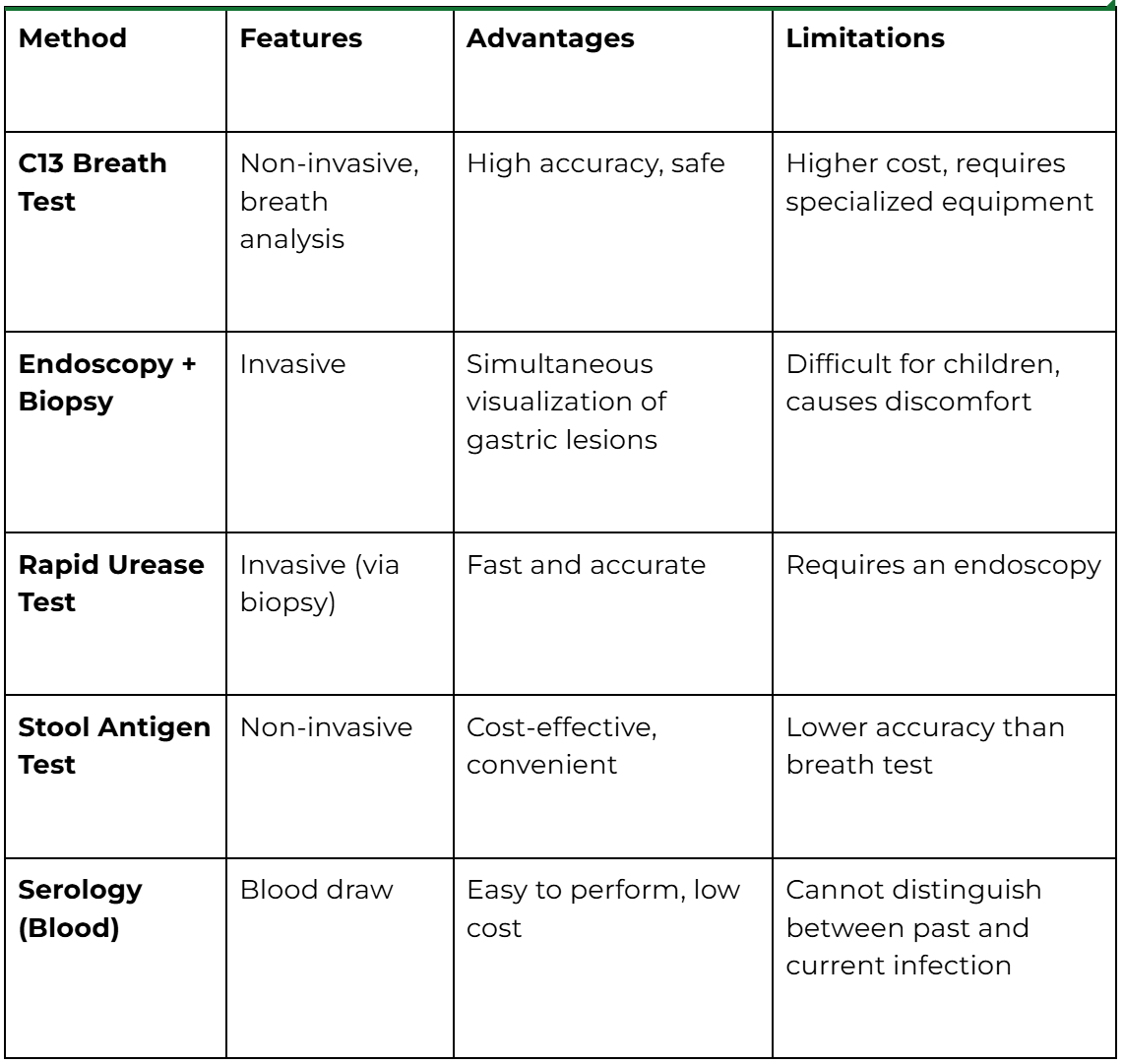
👉 The C13 Urea Breath Test is the preferred choice for diagnosis and follow-up when an endoscopy is not required or desired.
Is the C13 Urea Breath Test reliable?
When the pre-test preparation protocols are strictly followed, the results are highly accurate. However, false-negative results may occur in the following cases:
- Recent medication use: If the patient has recently taken antibiotics, PPIs, or bismuth.
- Localized infection: If the H. pylori infection is concentrated in a specific area rather than being distributed throughout the stomach.
- False-positives: Although rare, these can occur due to the presence of other urease-producing bacteria in the gastric system.
Conclusion
The C13 Urea Breath Test is a reliable, highly accurate, and safe diagnostic tool for detecting and monitoring H. pylori infection. It is an ideal non-invasive option for both children and adults, especially for post-treatment evaluation or when avoiding endoscopy is a priority.
However, this test should be indicated and interpreted by a gastroenterologist to ensure clinical accuracy and avoid self-misinterpretation of the results.
FAQ
1. Is fasting required?
Yes, patients must fast for at least 6 hours before taking the test.
2. Is the C13 Urea Breath Test safe for children?
Yes, it is a non-invasive and safe method for both pediatric and adult patients.
3. How soon after treatment can I re-test?
Wait at least 4 weeks after stopping antibiotics and 2 weeks after stopping PPIs.
4. What is the difference between C13 and C14 tests?
- C13: Uses a stable, non-radioactive isotope; safe for everyone.
- C14: Uses a low-dose radioactive isotope; not recommended for children or pregnant women.
5. Does a positive result mean I need an endoscopy?
Not necessarily. Unless you have "alarm signs" (weight loss, GI bleeding, anemia, persistent vomiting), a doctor may initiate treatment based on the breath test alone.
To book a C13 Urea Breath Test at DYM Medical Center Vietnam, please contact us via:
-
DYM Medical Center Saigon: Room B101-B103, Basement 1, mPlaza Saigon Building, No. 39 Le Duan, Sai Gon Ward, Ho Chi Minh City
-
DYM Medical Center Phu My Hung: Room 3A01, 3A Floor, The Grace Building, 71 Hoang Van Thai Street, Tan My Ward, Ho Chi Minh City
-
DYM Medical Center Hanoi: B1 Basement, Epic Tower, Alley 19 Duy Tan, Cau Giay Ward, Ha Noi
-
Hotline: 1900 29 29 37
Register now to receive the latest offers
Book an appointmentMedical specialties
- Corporate health check-up
- Dental Checkup Package
- Pediatric Examination Package
- Work Permit Examination Package - Work Permit Supplement
- Pre-wedding health check-up
- Obstetrics and Gynecology Package
- Cancer Screening Package
- Health check-up for individuals
- Japan pre-entry Tuberculosis Screening(Jpets)
- Food Handler package
- Medical examination for labor export to Japan
- Medical examination for specific skills to work in Japan (Tokutei)
Contact us
Reach out to DYM for quick support through
our official channels.